A scrubber quotation is only as reliable as the operating conditions behind it. By defining the process duty, matching the removal mechanism, testing the design basis, and checking the manufacturer’s system responsibility, you can compare bids on performance, risk, and lifecycle cost rather than vessel size alone.
Key takeaways
- Give every bidder minimum, normal, maximum, and upset gas conditions.
- Match scrubber type and liquid chemistry to the specific contaminant.
- Demand removal efficiency, pressure drop, and capacity guarantees with test methods.
- Verify materials, safety controls, maintenance access, and complete exhaust-system scope.
Define the Complete Operating Envelope Before Requesting Quotes
Give every scrubber manufacturer the same scrubber design basis: real minimum, normal, maximum, and upset conditions. A quote based on one gas-flow figure can meet removal efficiency at design point yet flood at maximum load, lose liquid wetting at turndown, or carry liquid into the fan.
- State gas flow in m³/h at minimum, normal, maximum, and upset conditions, including batch start-up, shutdown, and transition periods.
- Identify every contaminant, its concentration range and composition, required outlet concentration, operating hours, and whether emissions are continuous, intermittent, toxic, flammable, or corrosive.
- Record gas temperature, pressure, moisture or humidity, oxygen content, solids loading, particle size, droplets, and any condensation risk.
- Specify the scrubbing liquid: reagent, target pH or oxidation-reduction condition, liquid-to-gas ratio, liquid temperature, density, viscosity, surface tension, make-up-water quality, expected salt formation, blowdown rate, and allowable recirculating-solids concentration.
- State limits for pressure drop, noise, fan capacity, wastewater discharge, plume visibility, and available installation space.
Ask the manufacturer to show flooding point, normal operating point, turndown limit, and predicted pressure-drop curve using the actual liquid properties and solids loading—not clean water. Require the quotation to identify inlet and outlet sampling locations, gas temperature and humidity, liquid and gas flow rates, averaging period, and whether removal efficiency includes the mist eliminator.
These details make comparisons between suppliers meaningful for chemical industries.
Match the Scrubber Type and Liquid Chemistry to the Contaminant
Choose the removal mechanism before comparing vessel prices. Soluble gases need absorption into a liquid; particles need collision and capture; acid mist removal needs droplet control, not merely a reagent tank.
| Option | Best fit | Main limitation |
|---|---|---|
| Packed-bed scrubber | Soluble gases such as HCl, SO2, NH3, or chlorine, using alkaline, acidic, or oxidising liquor selected for the reaction | Packing floods, plugs, or loses performance when solids are high or liquid distribution fails |
| Spray-tower scrubber | Dirty gas, coarse particles, hot gas quenching, and duties requiring open passages | Lower gas-transfer area usually means larger vessels or higher liquid rates for the same absorption |
| Venturi scrubber | Fine particulate capture and gas streams where intense contact justifies high pressure drop | Fan energy rises sharply; dissolved-gas performance depends on downstream separation and reagent contact |
| Tray scrubber | Staged absorption where predictable residence time and concentration driving force matter | Trays can foul, weep at turndown, or flood at high flow |
| Fiber-bed or mesh-pad unit | Fine acid mist and submicron liquid droplets after generation at the source | Salt deposition and pressure-drop growth demand effective washing access |
For a packed-bed scrubber, demand the distributor type, minimum wetting rate, nozzle-orifice size, plugging tolerance, and distribution quality at turndown. An adequate packing depth cannot rescue dry channels.
Match the liquor to the reaction: caustic for acidic gases, acid for alkaline gases, and an oxidant only when the contaminant chemistry and materials permit it. Specify minimum, normal, maximum, and upset gas flow, solids loading, liquid chemistry, and outlet limit; otherwise the selected design may flood at maximum flow or lose wetting at turndown.
Include demister droplet rating, wash cycle, and allowable pressure drop.
Compare the Proposal Using Engineering Figures and a Testable Guarantee
A removal-efficiency guarantee means little without the calculation behind it. Require the manufacturer to show performance at minimum, normal, maximum, and upset gas flow, not only at one design point.
| Proposal item | Check the engineering figure | Warning sign |
|---|---|---|
| Gas contact | Gas velocity, packing type and depth, liquid-to-gas ratio, recirculation flow, and calculated contact time | Efficiency quoted without flooding or turndown limits |
| Pressure loss | Report scrubber pressure drop Pa and pressure drop mmWG at clean and fouled conditions, including the mist eliminator | Fan selection uses only the absorber’s clean pressure drop |
| Liquid chemistry | State reagent, pH or oxidation-reduction target, temperature, salt formation, blowdown, and allowable solids | “Caustic solution” or “water” appears without concentration or control limits |
| Performance test | Record inlet and outlet concentration, gas temperature, humidity, gas and liquid flow, sampling points, and averaging period | One removal percentage with no test basis |
Ask whether the guarantee covers the absorber alone or the complete system, including mist eliminator and duct losses. Demand outlet concentration as well as percentage removal; 99% removal from 1,000 ppm leaves 10 ppm, while the same percentage from 10 ppm leaves 0.1 ppm.
For variable emissions, require a test matrix covering concentration, flow, temperature, humidity, and reagent condition. A pilot test becomes essential when reaction chemistry, solids loading, or batch transitions change the duty. Define failure as an outlet value above the stated limit during the agreed averaging period, with sampling records supplied for verification.
Audit Materials, Safety Controls, and Maintainability Before You Approve the Vessel
Approve the vessel only after the manufacturer ties every wetted material to your contaminant, concentration, temperature, and cleaning chemical. SS 304 is not an automatic choice for chloride-bearing or acidic service; demand the compatibility basis for SS 316, FRP resin, or polypropylene, including laminate construction, corrosion allowance, and the specified PP sheet thickness.
1. Request material certificates, resin and laminate details, weld procedures, lining or laminate inspection records, and dimensional drawings. Require spark testing or holiday testing for non-metallic linings, weld examination where applicable, and hydrostatic or vacuum testing at the factory. A water-only test confirms leaks, not chemical resistance or removal efficiency.
2. Make the control narrative show the safe response to low recirculation flow, low tank level, high differential pressure, high pump discharge pressure, high sump temperature, abnormal pH, reagent loss, demister-wash failure, and fan failure.
A pump trip must stop or isolate the gas duty; a fan trip must prevent untreated gas bypass and protect packing from overheating or chemical attack. Simulate each alarm and interlock during factory acceptance testing.
3. Inspect the maintenance drawing for removable demister sections, packing and distributor access, sump cleanouts, drains, pump and instrument isolation, and safe nozzle removal. Confirm spare nozzles, seals, packing, liners, and demisters, plus inspection intervals and replacement life. A buried demister can turn salt deposition into rising pressure drop and an unplanned confined-space entry.
Also verify fan location, condensate drainage, isolation points, wetted duct materials, and static-pressure margin. A downstream fan reduces fugitive leakage upstream but demands effective demisting and drainage to prevent corrosive carryover.
Confirm the Manufacturer Can Deliver the Complete Exhaust System
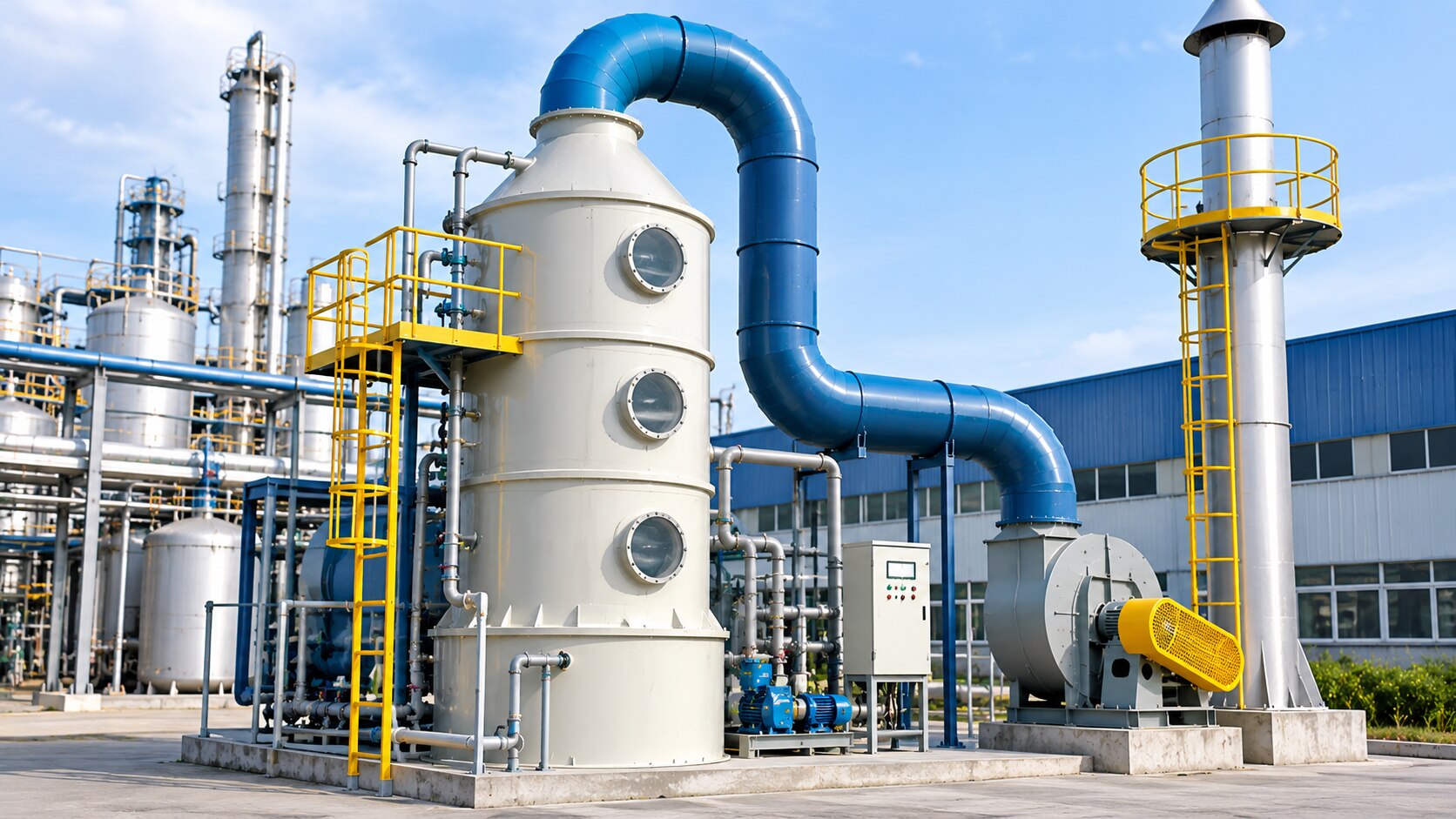
A vessel can meet its drawing dimensions and still fail as an exhaust system. A scrubber system integrator owns the gas path from the process connection to the discharge point, including fan duty, controls, chemical circulation, ducting and stack, whereas an isolated fabricator may deliver only the shell and internal supports.
Ask the bidder to provide these documents and responsibilities in writing:
- A process and instrumentation diagram showing the scrubber, pumps, dosing points, drains, isolation valves, instruments, blower, ducting and stack
- Blower selection based on total system pressure drop, gas temperature, density, moisture, and required flow at the operating point
- Ducting and stack drawings showing material, diameter, supports, access doors, drains, expansion provisions, and discharge height
- An interface matrix assigning electrical power, civil foundations, cable routes, utilities, commissioning, and operator training
- A commissioning plan covering liquid circulation, spray distribution, fan balancing, interlocks, and outlet sampling
The factory acceptance test must verify more than dimensions. Include material certificates, laminate or lining inspection, weld examination, hydrostatic or vacuum testing where applicable, pump and fan rotation, control-panel I/O checks, alarm and interlock simulation, nozzle spray patterns, and documented pressure-drop assumptions.
A water-only FAT cannot prove reactive absorption efficiency; confirm that representative-load performance testing will occur during site commissioning.
Ask Sri Krishna Fibre Industries to state which items it engineers, fabricates, installs, and commissions. That answer separates a complete-package contractor from a vessel supplier before a missing blower or undersized stack becomes your problem.
Related products
 | Pollution Control System Sri Krishna Fibre Industries, Bangalore, manufactures high-quality SS Scrubber Systems for industrial air pollution control, chemical fume... View product → |
 | Pollution Control System Sri Krishna Fibre Industries, Bangalore, manufactures high-quality MS + FRP Scrubber Systems for industrial air pollution control, chemical fume... View product → |
Frequently asked questions
What operating information should you give a scrubber manufacturer?
Provide minimum, normal, maximum, and upset gas flow; contaminant concentration and temperature; moisture content; pressure; particle loading; operating hours; and required outlet limits. Include turndown, startup, shutdown, and emergency conditions.
How do you select the right scrubber type?
Match the contaminant’s form and chemistry to the scrubber. Packed-bed scrubbers suit soluble gases, venturi scrubbers suit particulate and mist removal, and tray or spray designs suit different contact, fouling, and pressure-drop requirements. Confirm the choice against gas flow, liquid chemistry, temperature, and removal targets.
Which engineering figures should you compare in scrubber proposals?
Compare gas capacity, liquid-to-gas ratio, removal efficiency, outlet concentration, pressure drop, liquid carryover, recirculation rate, bleed rate, power demand, and turndown performance. Require each figure to state its test method and operating conditions.
What should you inspect before approving the scrubber vessel?
Check the proposed lining or alloy against the gas, liquid, temperature, and chloride or solvent exposure. Review mist eliminator access, spray and nozzle maintenance, drains, inspection ports, level controls, interlocks, corrosion allowance, and replacement procedures.
What should a complete scrubber-system quotation include?
Confirm whether the scope covers the vessel, pumps, tanks, nozzles, mist eliminator, ductwork, fan, motor, dampers, instruments, control panel, stack connection, installation, commissioning, performance testing, and operator documentation.
Related products
 | Pollution Control System Sri Krishna Fibre Industries, Bangalore, manufactures high-quality MS Scrubber Systems for industrial air pollution control, fume extraction, gas... View product → |
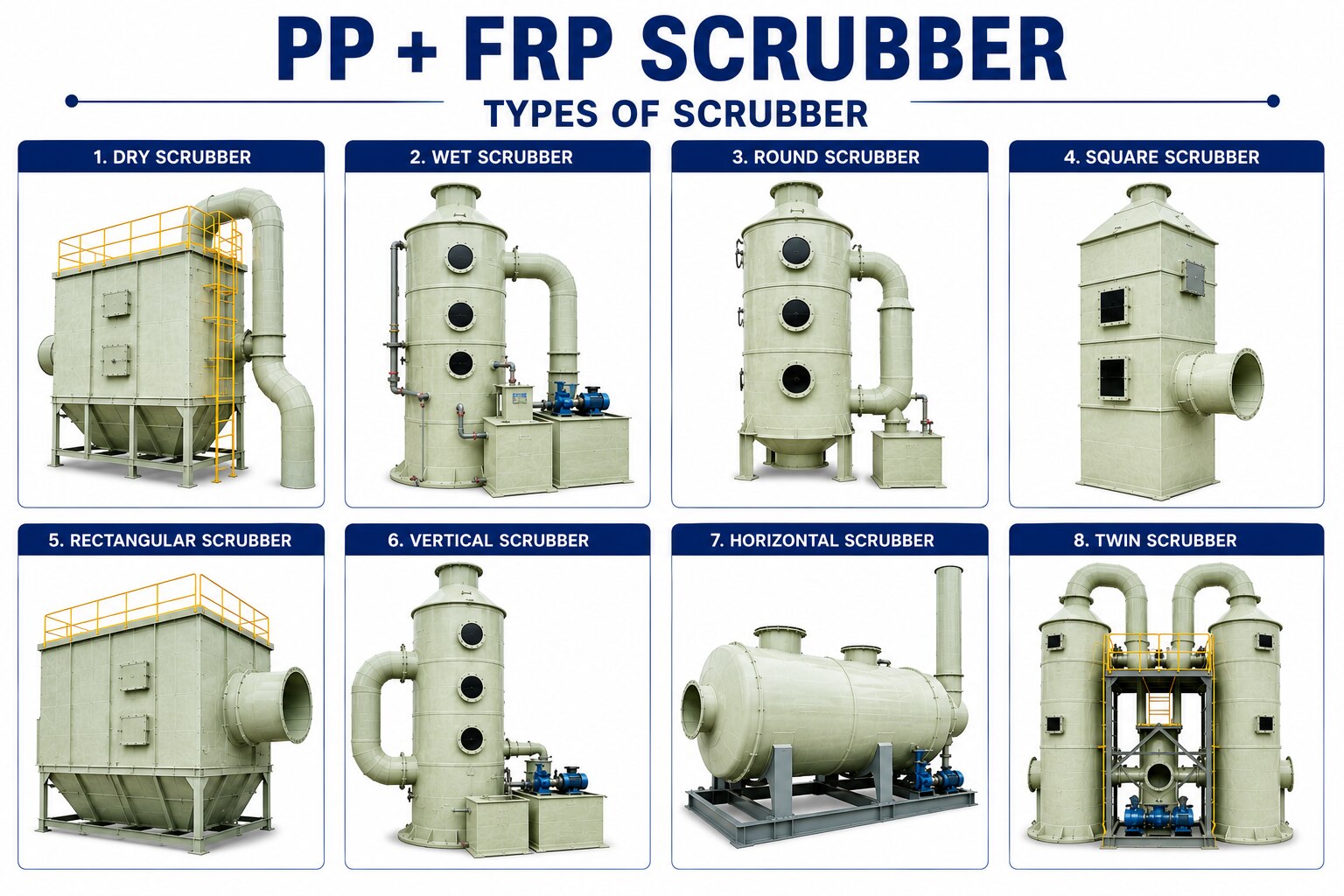 | Pollution Control System Sri Krishna Fibre Industries, Bangalore, manufactures high-quality PP + FRP Scrubber Systems for industrial air pollution control, chemical fume... View product → |